
PRACTICAL GUIDE · FIELD NOTES
Review Context Before Productivity Scores
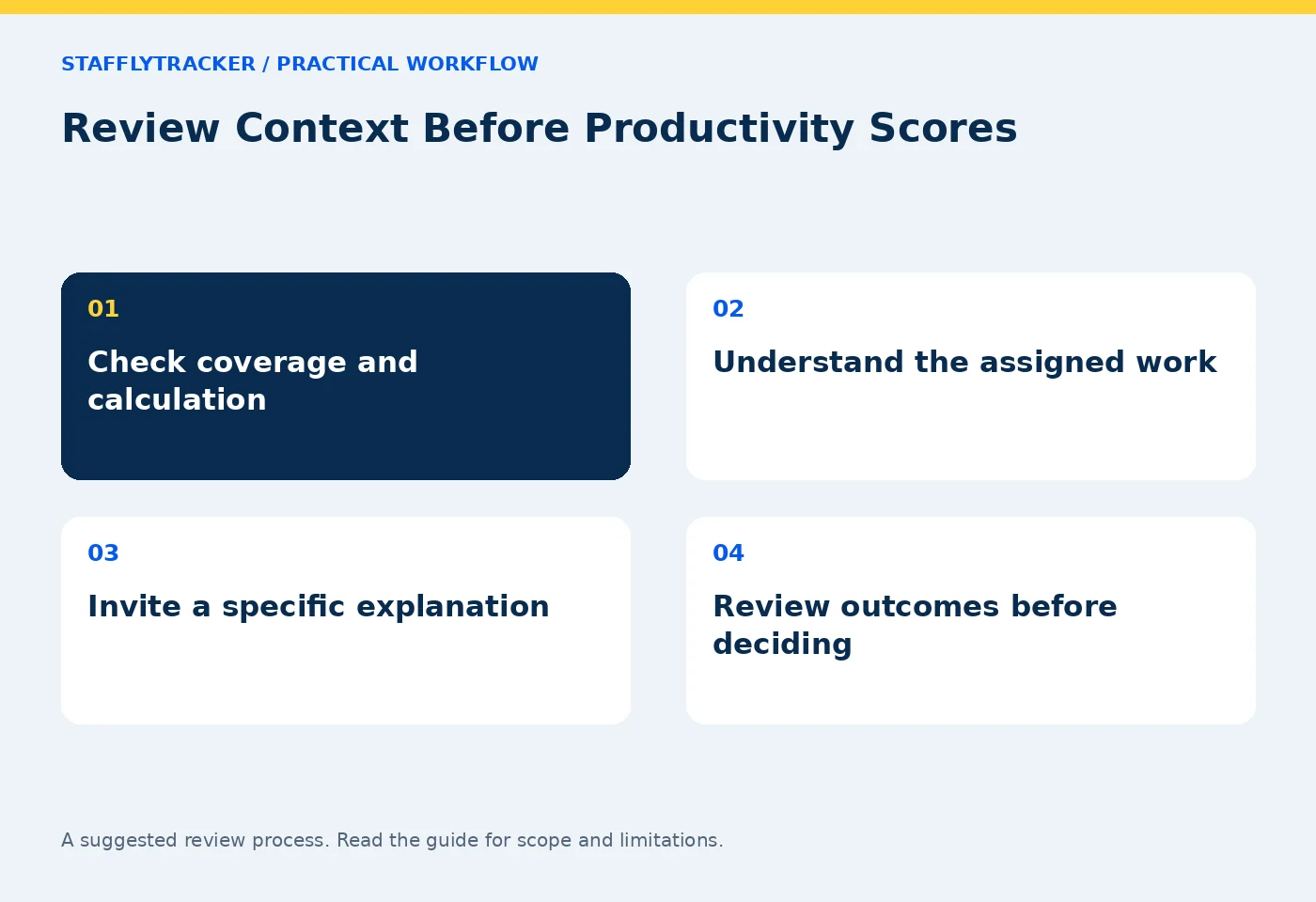
Review context before productivity scores: check coverage, assignments, evidence and outcomes before making a decision about an employee.
StafflyTracker editorial · Product by Syed Toheed Shah

A productivity percentage is a summary of selected signals, not a complete measure of a person's contribution. Before acting on it, check the calculation, coverage, job context and actual work outcome. An unusual score should start a review, not finish one.
This matters in both directions. A low-input day can include valuable reading or calls. A high-input day can include repetitive actions that produce little useful output. Neither conclusion can be reached from the percentage alone.
Ask what the number measures
Find the numerator, denominator and treatment of missing data. Does the report describe active input within monitored time, time in categorized applications or another calculation? Labels such as “performance” can imply more than the underlying data supports.
Check whether the work period includes idle time and whether missing coverage is separately visible. A total that looks tidy can still hide an important unknown interval. The data quality guide provides a practical checklist.
Do not compare scores from different roles or configurations as though they were standardized output measures. A call specialist, designer and data-entry employee may interact with a computer very differently.
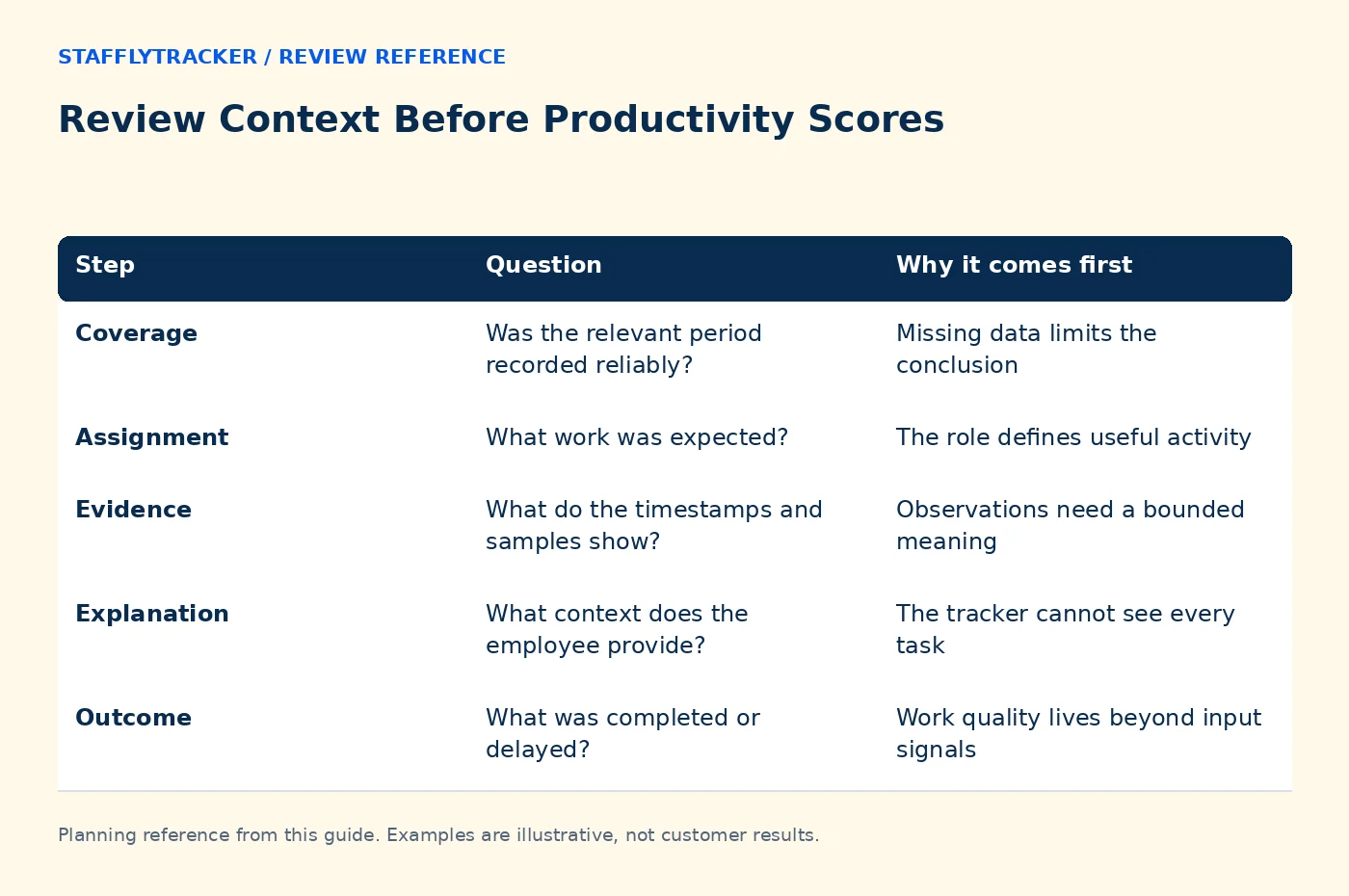
Follow a context-first sequence
| Step | Question | Why it comes first |
|---|---|---|
| Coverage | Was the relevant period recorded reliably? | Missing data limits the conclusion |
| Assignment | What work was expected? | The role defines useful activity |
| Evidence | What do the timestamps and samples show? | Observations need a bounded meaning |
| Explanation | What context does the employee provide? | The tracker cannot see every task |
| Outcome | What was completed or delayed? | Work quality lives beyond input signals |
| Decision | What action is justified? | Conclusions should follow the review |
Keep these steps visible in the review notes. It becomes easier to explain a decision and to correct it when new information appears.
Understand a static-screen example
Suppose a screen looks unchanged for an hour. The employee may be reading a long document, speaking on a call, working from printed material or away from the task. The image alone cannot distinguish those possibilities.
Look at the assigned work, available time-aligned activity, any monitoring gaps and the employee's explanation. If an outcome should exist, review it in the system responsible for that work. Avoid using screenshot similarity as a substitute for a conversation or a work-quality check.
A repetitive input pattern can justify a more specific question, but it still does not establish intent by itself. Detection signals should be described as indicators with limitations, not as a guaranteed verdict.
Separate tool evidence from behavior
A software inventory may show an installed utility. Historical launch evidence may show it ran at an earlier date. Neither alone proves it was used during the interval under review.
The software inventory checklist explains this evidence ladder. If the available evidence cannot determine current use, say so. A precise uncertainty is more responsible than an unsupported accusation.
This approach does not mean ignoring suspicious patterns. It means investigating them with the same care used to investigate a technical fault or an attendance discrepancy.
Avoid converting a score directly into pay
Recorded attendance, approved adjustments and the company's pay rules need their own reconciliation. Automatically multiplying wages by an activity percentage can turn measurement limitations into a financial error.
For example, idle time may already be part of worked time, and calls may involve little mouse movement. A tracker outage creates unknown coverage, not a measured failure to work. Review attendance before payroll and resolve the relevant exceptions through the approved process.
This is an operational caution, not legal or payroll advice. Your company must apply its policies and applicable requirements with appropriate review.
Use the review to improve the work system
Sometimes a pattern points to a process problem: a slow application, an unclear assignment, repeated waiting for approvals or a role whose work is poorly represented by input activity. Fixing that issue may be more useful than demanding a higher score.
Keep a short record of the finding, action and follow-up date. If the review shows no justified concern, close it clearly rather than leaving a permanent suggestion of wrongdoing attached to an ambiguous signal.
Common questions
Is a 100% score proof of excellent work?
No. It describes the metric's calculation under its available data. Output, quality and context remain separate questions.
Is a low score proof someone was idle all day?
No. Check coverage, work type and the calculation before interpreting it.
What should buyers ask vendors?
Ask for metric definitions, missing-data behavior and a call-heavy or reading-heavy example. Use the demo comparison guide and try the StafflyTracker demo with those questions prepared.
KEEP EXPLORING
Make the next decision clearer.
Time Tracking for Accounting Firms Employee Time Tracking Buyer’s ChecklistSEE THE WORKFLOW
Bring your questions.
Try the actual interface.
Explore fictional records, then discuss the requirements that matter to your team. Email required; phone optional.
AI-assisted editorial content and original illustrations. Examples are illustrative, not customer results. Editorial policy · Current product availability · Read as Markdown